


You're posting consistently. People reply to Stories. A few Reels perform well. Brands occasionally like your content. Yet the income still isn't there, or it shows up in random bursts that don't feel like a business.
That's where most creators get stuck. They try to answer how to monetize instagram account by collecting tactics: affiliate links, sponsored posts, digital products, subscriptions. But tactics without a system create scattered results. Instagram is excellent at helping people discover you. It's much weaker at helping you convert attention into sales, leads, bookings, and repeat revenue.
The fix is to stop treating your profile like a content gallery and start treating it like the front end of a business. Instagram brings people in. Your off-platform funnel does the heavy lifting. That means your profile, content pillars, offers, and bio link setup all need to work together.
Table of Contents
- From Followers to Revenue A New Monetization Mindset
- Laying the Foundation for a Profitable Account
- Exploring Your Instagram Income Streams
- The Creator's Toolkit for Pitching and Pricing
- Your Bio Link The Central Hub for Conversion
- Tracking Success and Optimizing Your Strategy
From Followers to Revenue A New Monetization Mindset
A common scenario looks like this: a creator builds a respectable audience, gets solid engagement, and still says, “I don't know how to turn this into money without becoming a full-time salesperson.” The problem usually isn't effort. It's the model.
Most advice still treats Instagram monetization like a scale game. Get more followers, then brands will care. Get bigger, then sell. Get lucky, then earn. That's outdated.
Recent creator-market guidance points in a different direction. Monetization is increasingly tied to trust signals and niche clarity, not just reach, and a 5,000-follower audience with strong purchase intent can often outperform a 100,000-follower entertainment account with weak intent according to Foursixty's Instagram monetization policy overview.
That changes how you should think about your account.
If you're a local service provider, niche educator, coach, product reviewer, B2B writer, designer, or maker, you do not need a giant audience to start earning. You need the right audience, a clear promise, and a path that moves people from content to action.
Strong monetization usually starts when a creator stops asking “How do I get bigger?” and starts asking “What exactly do I want this audience to do next?”
Instagram works best as the top of the funnel. People discover your content, get familiar with your point of view, and decide whether they trust you. The sale, booking, signup, or application often happens somewhere else.
That's the new mindset. You're not just growing a following. You're building a conversion system around attention you already have.
Laying the Foundation for a Profitable Account
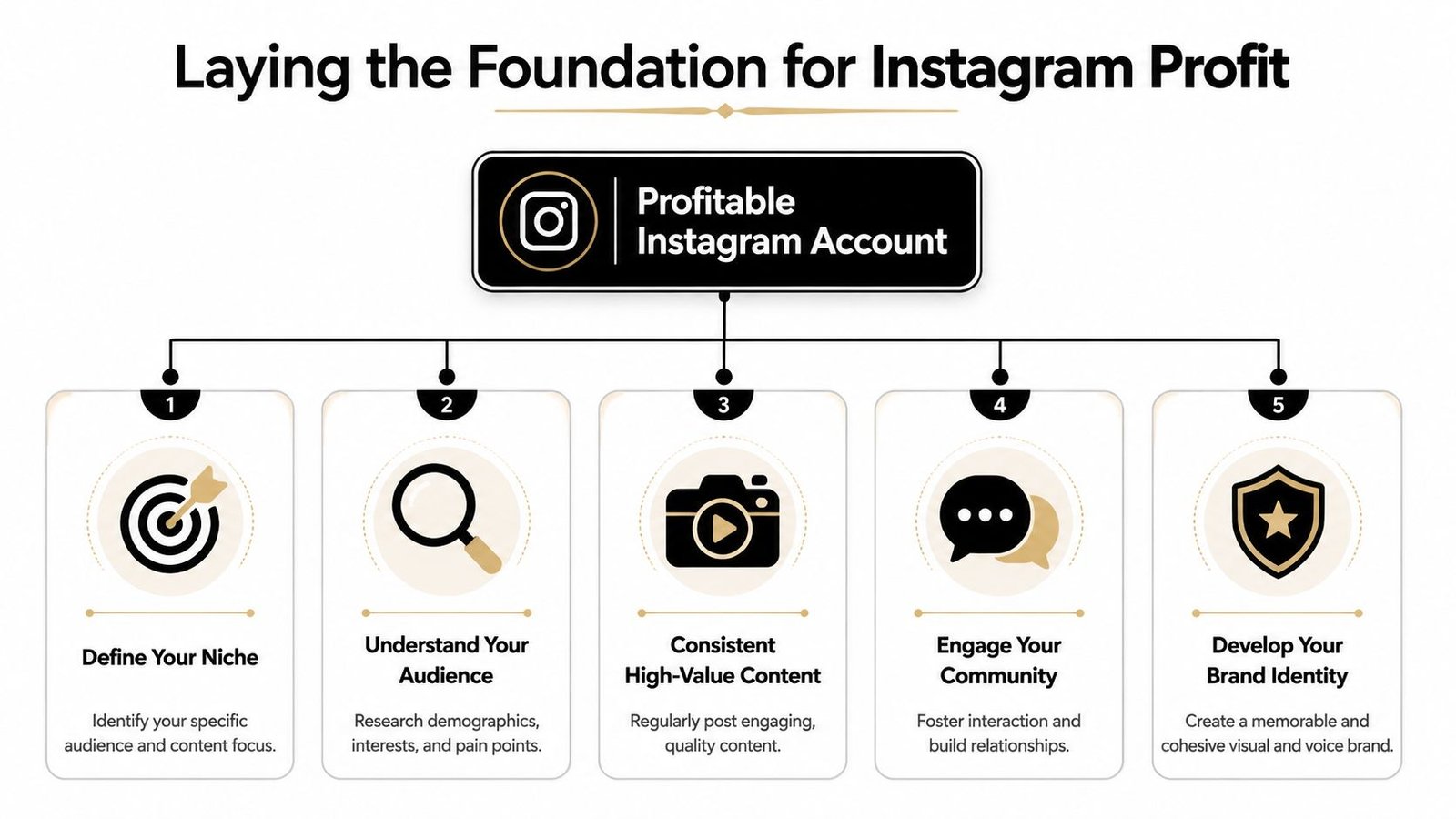
A profitable Instagram account is built before the first brand deal, affiliate sale, or product launch. It starts with positioning, publishing discipline, and a profile structure that sends people somewhere useful after they discover you.
If your account attracts attention but gives visitors no clear next step, revenue stays inconsistent. Instagram can create demand. Your funnel has to capture it.

Start with a professional account and a clear niche
Use a Creator or Business account. You need the analytics, contact options, category labeling, and business features that personal profiles lack. Earlier guidance from InfluenceFlow also points to niche clarity as a core part of monetization setup, so the operating principle is simple. Broad content gets passive views. Specific content attracts buyers.
Your niche does not need to be narrow to the point of starvation. It needs to be clear enough that a stranger can understand three things fast: who you help, what topic you own, and what kind of outcomes your content supports.
Strong examples:
- Fitness for busy parents
- Skincare for acne-prone adults
- Content strategy for coaches
- Home organization for small apartments
Weak positioning usually sounds like this:
- Lifestyle
- Business tips
- Motivation
- Travel and fashion and mindset and food
I usually tell creators to test their niche with a simple profile audit. If a qualified follower lands on your page, can they tell within a few seconds whether you are relevant to their problem? If not, your monetization problem starts at positioning, not pricing.
Build repeatable content pillars
Revenue gets easier when content is repeatable. Random posting creates random demand.
Set up 3 to 5 content pillars that support both audience growth and buyer trust. A practical structure looks like this:
Education
Teach one useful idea, framework, or tactic your audience can apply.Proof
Show results, client work, product use cases, testimonials, process screenshots, or behind-the-scenes decisions.Opinion
Publish clear takes on bad advice, common mistakes, and shifts in your niche.Personal context
Give people enough story and perspective to understand why your advice is credible.Offer-related content
Explain what you sell, who it is for, and what happens after someone clicks.
For creators using Reels as a discovery channel, reach improves when topics, hooks, and distribution are planned together instead of treated as separate tasks. A practical guide to best hashtags for Instagram Reels can help you tighten category relevance without turning every caption into keyword clutter.
Turn attention into trust
Trust is built through pattern recognition. People need to see a consistent promise, a consistent point of view, and a consistent path to act.
That does not require polished branding. It requires alignment.
Focus on a few habits that compound over time:
Sharpen your profile promise
Your bio should state who you help, what value you provide, and where people should go next.Reply like an operator, not a broadcaster
Comments and DMs reveal objections, buying language, and content gaps. That feedback should shape future posts, offers, and landing pages.Keep your formats recognizable
Consistent hooks, visuals, and teaching style make your content easier to remember.Send people off-platform intentionally
A strong post should not end with attention alone. It should push the right viewer toward an email opt-in, booking page, waitlist, product page, or application form.
Practical rule: If someone lands on your profile and cannot tell what you do, who it helps, and where to go next, every monetization model gets harder.
Creators who are still trying to stabilize reach can also study these practical ways for how to grow social media following without relying on short-term hacks.
The goal at this stage is not more content for its own sake. The goal is an account structure that turns discovery into qualified clicks, and qualified clicks into measurable action off-platform.
Exploring Your Instagram Income Streams
Once the foundation is solid, monetization gets easier because each revenue stream has something to plug into. The mistake is choosing only one method too early and expecting it to carry the whole business.
Instagram is no longer just a social app. Business of Apps estimates Instagram generated $66.9 billion in revenue in 2024, which shows how mature the platform's commerce ecosystem has become. That same overview also notes that creators need to use the Paid Partnership label whenever there's an exchange of value with a brand in posts, Reels, Stories, or Live content, according to Business of Apps' Instagram statistics page.
Sponsored content
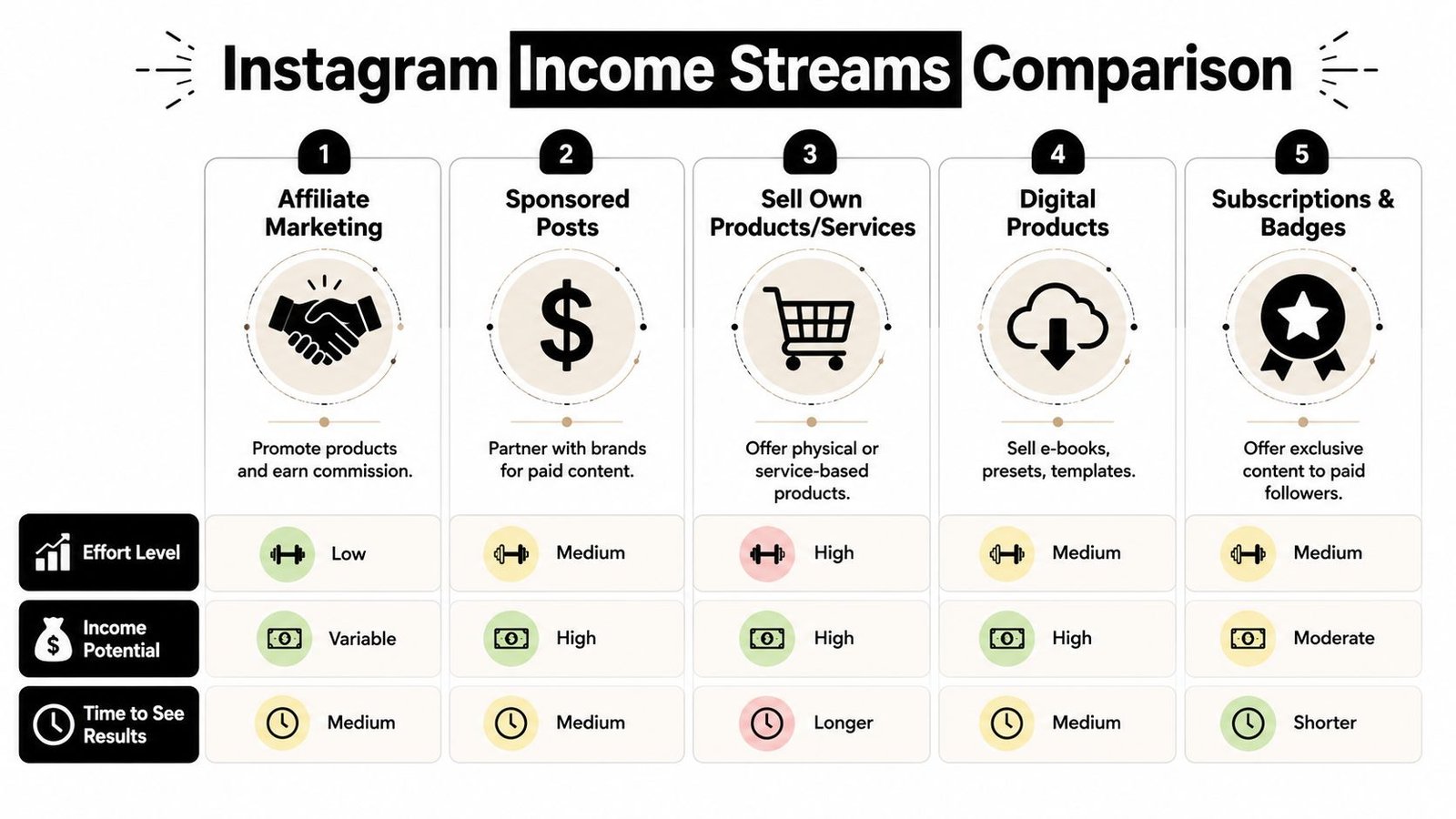
Sponsored posts are still the most visible monetization path, but they work best when your audience is defined and your content already influences behavior.
Best fit: creators with a clear niche, consistent content quality, and proof that followers act on recommendations.
Upside: strong upside per deal, good for relationship building with brands, and often easier to scale than low-ticket offers.
Trade-off: income can be inconsistent. If your whole business depends on brand deals, your revenue is tied to other people's budgets and campaign cycles.
A practical move for newer creators is to browse marketplaces where brands already look for creators. Platforms like JoinBrands can help you understand what brands request and how creators package deliverables.
Affiliate marketing
Affiliate revenue is often overlooked because it doesn't feel glamorous. In practice, it's one of the cleanest ways to monetize a smaller but trusted audience.
Best fit: reviewers, educators, niche creators, and anyone who naturally recommends tools, products, books, software, or gear.
Upside: no fulfillment, no customer support, and no need to create your own product.
Trade-off: you don't control the offer, the landing page, or the commission structure. If the brand changes terms, your income changes too.
Affiliate content works when the recommendation is contextual. Tutorials, comparisons, routines, and “what I use” posts usually outperform generic promotion.
A good rule is simple: if you wouldn't recommend it unpaid, don't build affiliate content around it.
Here's a useful walkthrough if you want a visual breakdown of different monetization paths:

Your own products and services
For most niche creators, this is the most impactful path because you control the offer and the margin.
This category includes:
- Services such as coaching, consulting, design, photography, copywriting, and strategy
- Physical products such as merchandise, books, or niche goods
- Hybrid offers like audits, retainers, workshops, or memberships
Best fit: creators with expertise or a direct solution to a problem.
Upside: full control over positioning, pricing, and customer relationship.
Trade-off: you need a real offer, not just content. You also need a clear fulfillment process.
Many creators discover that their Instagram content isn't the business. It's the sales layer for the business.
Digital products
Digital products sit in a sweet spot between services and sponsorships. They can be sold repeatedly without requiring you to be present every time.
Examples include:
- Templates
- Guides
- Presets
- Mini-courses
- Swipe files
- Checklists
- Paid workshops
Best fit: educators, creators with repeatable processes, and anyone whose audience asks the same questions repeatedly.
Upside: scalable, flexible, and often easier to test than a big course.
Trade-off: low-quality digital products die quickly. If the product doesn't solve a specific problem, people won't buy just because they like your content.
The strongest digital products usually come from content that already performs well. If people save, share, and DM you about one topic, that topic often has product potential.
Subscriptions and badges
Instagram's native monetization tools can work well when your audience wants ongoing access, community, or more direct interaction.
Best fit: creators with loyal followers who want exclusive content, recurring access, or live engagement.
Upside: recurring revenue potential and closer audience relationships.
Trade-off: you must keep delivering. Subscription fatigue is real, and weak exclusivity kills retention.
These tools work best as part of a broader model, not the whole model. If you use them, make the subscriber value obvious. Extra access, private Q&A, deeper teaching, or member-only resources are clearer than “support me if you want.”
The Creator's Toolkit for Pitching and Pricing
A lot of creators wait for inbound brand deals far too long. If your niche is clear and your content moves people, you can pitch.
Instagram's scale gives you a strong business case. By 2026, Instagram is projected to have around 3 billion monthly active users, and about half of users discover new brands while browsing the app, according to Hootsuite's Instagram statistics roundup. That matters when you pitch because you're not selling a pretty post. You're selling visibility inside a platform where discovery already happens.
What your media kit needs
Your media kit should make one point clear: your value is not your follower count alone.
Include:
Who you are
One short paragraph with your niche, audience, and content style.Audience snapshot
Demographics, interests, and buyer relevance. Keep this factual and concise.Content formats
Reels, Stories, carousels, Lives, UGC-style content, product demos, or tutorials.Past brand alignment
Even unpaid examples count if they show fit and quality.Action metrics
Comments, shares, saves, DMs, clicks, and any signal that shows intent.Ways to work together
Sponsored posts, Reels packages, Stories, UGC production, affiliate partnerships, or long-term campaigns.
If you need a clean planning starting point, this brand strategy template helps organize your niche, messaging, and positioning before you turn them into a media kit.
How to pitch brands without sounding desperate
Bad pitches usually focus on the creator. Good pitches focus on fit.
Keep your outreach short. Mention the product, why your audience matches it, the kind of content you can create, and one reason your angle is useful.
A practical pitch structure:
- Specific brand reference
- Why your audience is relevant
- The content angle you'd create
- A light call to continue the conversation
Don't send a generic “I'd love to collaborate” message to twenty brands and expect quality replies. Personalized outreach gets fewer sends and better odds.
Brands respond faster when the pitch already sounds like campaign thinking, not creator wishful thinking.
A simple way to set starting prices
There is no universal rate card that works for everyone. Pricing depends on niche, content quality, usage rights, turnaround, exclusivity, and whether the brand wants access to your audience, your production skills, or both.
Start with a simple structure:
- Base price for the content format
- Add-ons for extra deliverables
- Add-ons for usage rights or whitelisting
- Add-ons for rush timelines or exclusivity
If you want a market reference point, this guide on instagram influencer pricing 2026 is helpful for understanding how brands think about rates.
Here's a practical sample pricing card you can adapt.
| Content Type | Follower Range | Starting Price (USD) |
|---|---|---|
| Story set | Any | Custom |
| Reel | Any | Custom |
| Carousel post | Any | Custom |
| UGC video for brand use | Any | Custom |
| Monthly package | Any | Custom |
That table is intentionally simple. If you try to force your work into rigid public pricing too early, you'll undercharge on the deals that need customization. Use a starting card as a conversation tool, then quote based on scope.
Your Bio Link The Central Hub for Conversion
Most monetization advice says “put the link in your bio” and stops there. That's incomplete. The single link is not the strategy. What happens after the click is the strategy.

Why one link is not enough
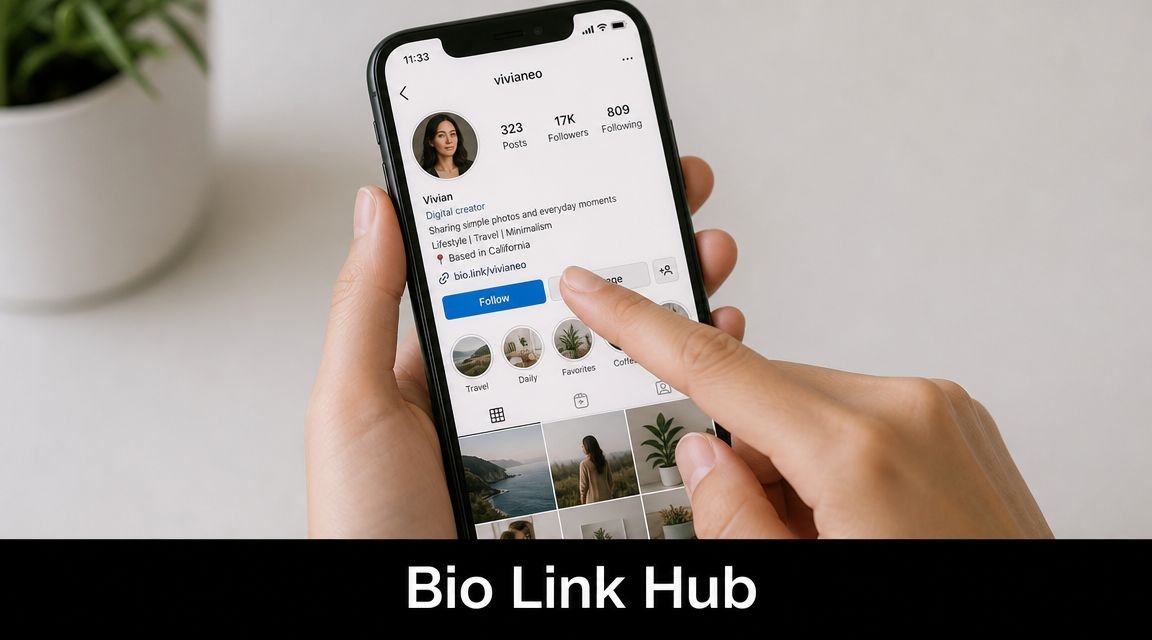
Instagram still creates friction around outbound clicks, and many in-app commerce options are limited by region. That's why off-platform infrastructure matters so much. A mobile-first bio link page lets you route people to products, booking pages, lead magnets, and offers from one destination, as explained in Printify's guide to monetizing Instagram.
This matters whether you sell services, affiliate products, digital downloads, or branded collaborations. Without a conversion hub, every CTA competes for the same tiny piece of profile real estate.
Think about the typical creator with multiple goals:
- Book calls
- Sell a template
- Recommend affiliate tools
- Grow an email list
- Show a portfolio
- Take inbound brand inquiries
A single static homepage link doesn't handle that well on mobile.
What to put on your bio link page
Your bio link page should reflect your business model, not just list every possible destination.
Useful blocks often include:
Primary offer first
Put the main thing you want sold or booked at the top.Secondary paths
Newsletter signup, affiliate recommendations, content library, or application form.Social proof or portfolio
Brand work, sample content, product previews, or service examples.Contact options
Inquiry form, email, or booking tool.Segmented buttons
“Work with me,” “Shop resources,” “My gear,” or “Start here.”
One straightforward option is a link in bio tools comparison and guide, especially if you're deciding how to organize products, content, and contact paths in one place. If you want a builder that supports links, products, videos, articles, and contact options on a mobile-first page, Bio Links Page Builder is one example that fits that use case.
A bio link page should act like a tiny storefront, not a junk drawer.
How to structure the page for action
Order matters more than people think.
Start with the action tied closest to revenue. Don't make visitors dig through ten equal-weight buttons. If your main income comes from services, your booking or inquiry CTA should be obvious. If it comes from digital products, show the product first. If affiliate income matters, group recommendations into a clean, intentional section.
Keep the page:
- Short enough to scan
- Clear enough to choose
- Focused enough to convert
The best-performing setup usually matches your content. If your Reel talks about a template, the bio page should make that template easy to find. If your Stories promote a consultation, the booking button should be near the top. Alignment between content and destination is where conversion improves.
Tracking Success and Optimizing Your Strategy
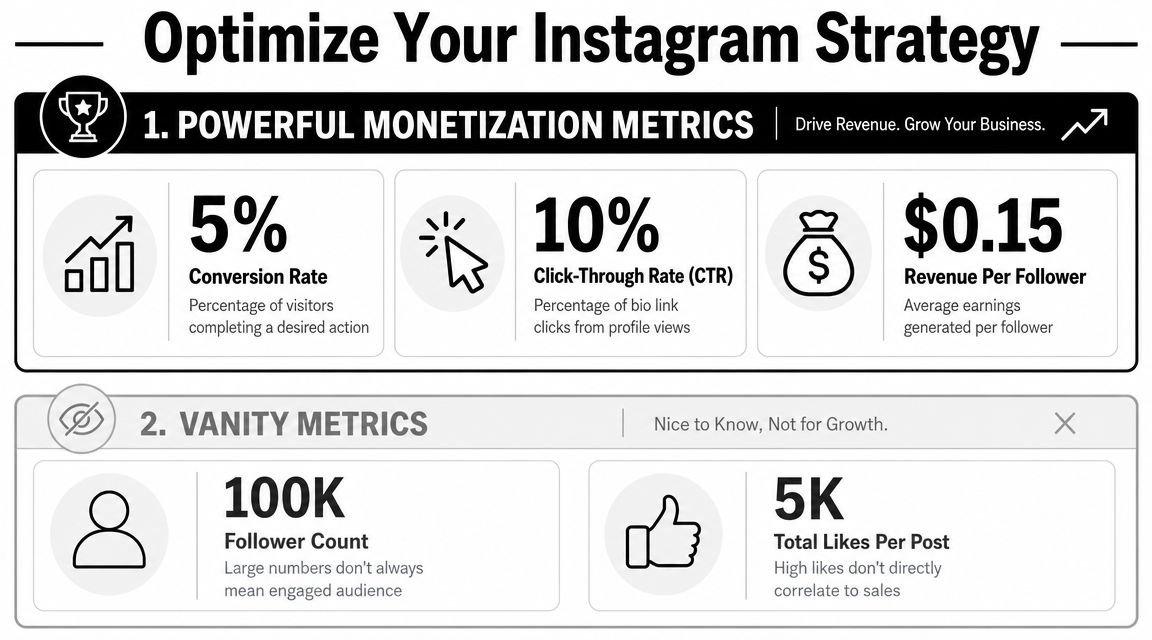
Creators stall when they measure what feels impressive instead of what leads to revenue. Likes can be encouraging. Follower count can be socially validating. Neither tells you enough about whether the business is working.
Industry guidance is blunt on this point. The biggest monetization error is optimizing for vanity metrics, while stronger indicators include comments, shares, saves, link clicks, and purchases. It also recommends measuring conversion rates by content format because engagement quality is more closely tied to revenue than raw follower totals, according to Communipass on common creator monetization mistakes.
Track buying signals, not vanity signals
The most useful questions are practical:
- Which posts drive profile visits?
- Which Stories trigger replies or clicks?
- Which Reels lead to DMs?
- Which offers get taps from the bio link page?
- Which content leads to actual purchases or inquiries?
Those are buying signals. They tell you where intent exists.
Follower growth still matters, but only in context. A smaller audience that clicks, replies, saves, and buys is worth more than a larger audience that watches and leaves.
Use content data to improve revenue
Review performance by format, not just by post. Carousels may drive saves. Stories may generate DMs. Reels may drive profile visits. The point isn't to crown one format as best. The point is to assign each format a job.
A simple operating rhythm works well:
- Publish with a clear CTA
- Watch for high-intent actions
- Compare content formats
- Repeat what moves people closer to purchase
You should also test small changes:
- CTA wording in captions
- Story frames that lead to clicks
- Different button order on your bio page
- Offer positioning by audience segment
When a post gets modest reach but produces inquiries, saves, or purchases, keep studying it. Revenue often hides inside content that doesn't look flashy.
Sustainable monetization comes from tightening the loop between content, offer, and conversion path. Not from chasing every trend.
If Instagram is your discovery engine, your link hub should be built like a conversion asset, not an afterthought. Bio Links Page Builder gives creators and businesses one mobile-first page to organize offers, products, videos, articles, and contact options behind a single bio link, which makes it easier to turn scattered profile traffic into measurable actions.