


You open Instagram or TikTok, check your notifications, and see a weird mix of activity. A few comments say “nice pic dear” on a post that has nothing to do with the comment. A new follower has no real profile photo, follows thousands of people, and somehow already sent you a DM about investing. Then you notice something more confusing. One follower looks sparse and private, but they might be a real person using an alt account.
That's where this topic gets messy for creators, freelancers, and agencies. If you've ever asked what's a spam account, the simple answer is “a fake or abusive account.” The practical answer is more nuanced. Some accounts are built to scam, manipulate, or flood platforms with junk. Others are legitimate secondary accounts people use for privacy, niche interests, or testing content away from their main public identity.
If you manage a brand, a creator profile, or multiple client accounts, that distinction matters. You want to filter out bad actors without misreading every quiet, private, or secondary profile as malicious.
Table of Contents
- Defining Spam Accounts Beyond Just Bots
- The Anatomy of a Spam Account Red Flags to Spot
- Common Types of Spam Accounts and Their Motives
- How Spam Accounts Hurt Your Brand and Analytics
- Your Action Plan for Reporting Blocking and Reducing Spam
- Building an Authentic Audience in a World of Spam
Defining Spam Accounts Beyond Just Bots
A spam account is any account used primarily to deceive, manipulate, promote unwanted content, or abuse platform systems. Sometimes that account is fully automated. Sometimes a real person runs it. The core issue isn't whether a bot is involved. It's the account's purpose and behavior.
Malicious spam accounts usually exist to do one or more of these things:
- Push scams such as fake giveaways, fake support messages, or investment pitches
- Spread junk content through repetitive comments, tags, follows, or DMs
- Impersonate real people or brands to steal trust
- Artificially inflate metrics with fake follows, likes, or low-quality engagement

The part that confuses most people
Not every account people casually call “spam” is malicious. Some are secondary accounts, often called alt accounts or finstas. People use them to separate audiences, follow sensitive topics privately, or keep their main profile more polished.
As Hootsuite's explanation of spam accounts and secondary profiles notes, legitimate users often create secondary accounts as a privacy strategy. That includes Instagram accounts used to follow sensitive content without affecting a primary profile's public image, and secondary emails used for low-priority sign-ups.
That means a sparse account isn't automatically dangerous. A private account with a small circle of friends may be personal. A niche account with low posting volume may belong to a real customer who only uses that profile for one interest.
Practical rule: Judge accounts by pattern, not by one trait.
A more useful way to think about it
Instead of sorting every account into “real” or “fake,” use three buckets:
| Account type | Main purpose | What you usually see |
|---|---|---|
| Malicious spam account | Abuse, scams, manipulation | Repetitive messages, suspicious links, odd identity signals |
| Legitimate secondary account | Privacy or audience separation | Limited posts, private settings, narrow interest focus |
| New or inactive real account | Normal low activity | Basic profile, inconsistent posting, but no abusive behavior |
This framework helps when you're cleaning up followers, moderating comments, or reviewing traffic quality. A quiet account may still be a customer. A polished account may still be a scammer. Behavior tells you more than appearance alone.
Why creators should care
If you run multiple accounts for different brands, projects, or content styles, you're part of this gray area too. Plenty of professionals separate a personal profile, a creator account, a client-facing account, and a testing account. That isn't spam. It becomes risky when the accounts look disconnected, post in robotic patterns, or interact in ways that resemble manipulation.
So when someone asks what's a spam account, the clearest answer is this. It's an account designed or used to create low-quality, deceptive, or abusive activity. But smart account management also means recognizing that some “extra” accounts are normal parts of online life.
The Anatomy of a Spam Account Red Flags to Spot
Most spam accounts reveal themselves in clusters of signals. One odd username by itself doesn't prove anything. One empty profile photo doesn't either. But when several warning signs appear together, the picture gets clearer.
A quick visual checklist helps: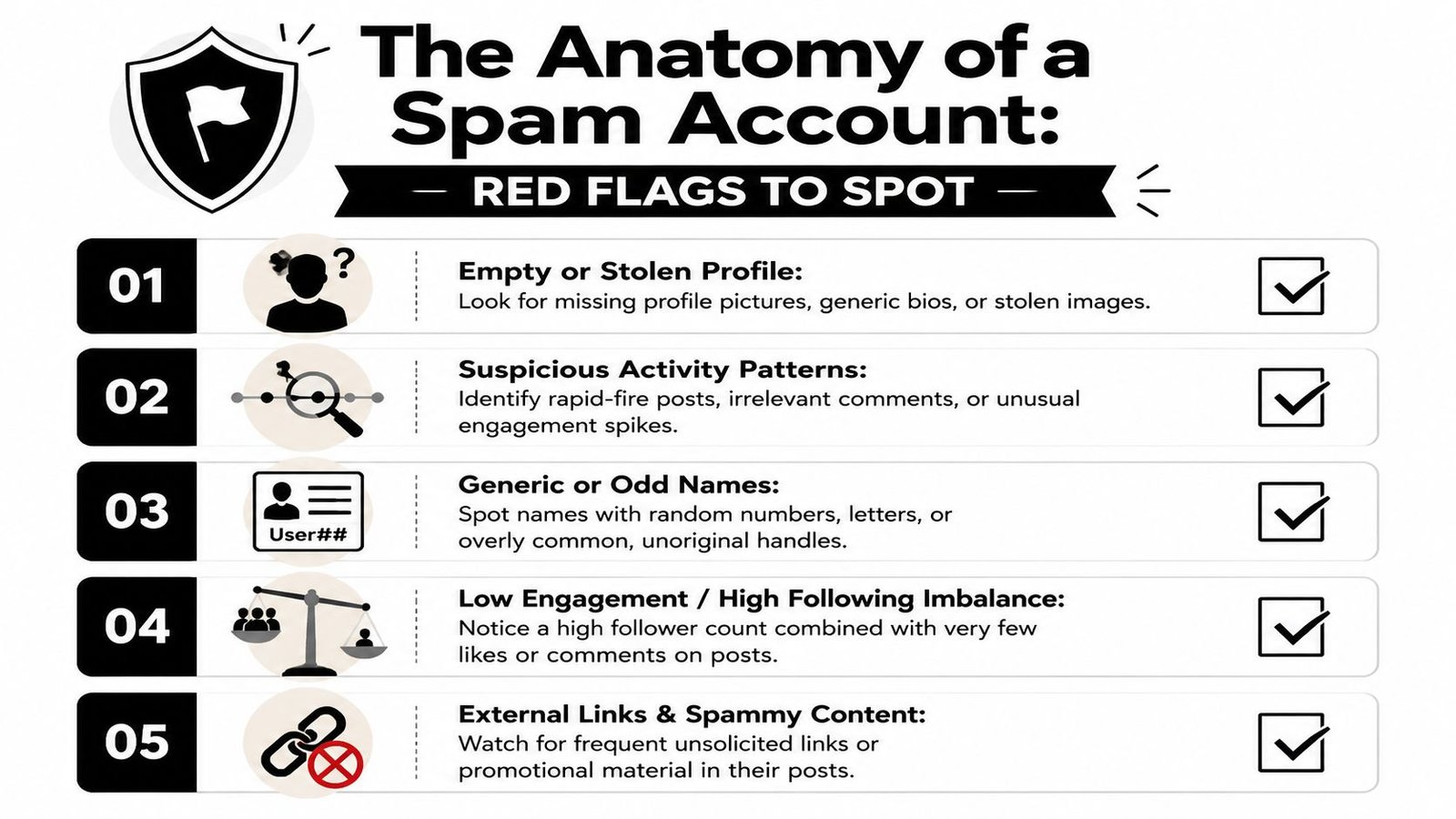

What your eyes can catch first
Start with the basics. Spam accounts often look unfinished, borrowed, or mass-produced.
- Profile identity looks thin. Missing profile picture, generic bio, or a photo that feels stolen or overly polished.
- Username feels assembled, not chosen. Random letters, long number strings, or a handle that looks auto-generated.
- Content lacks context. Few posts, no clear personality, and captions that could fit any account.
- Following behavior looks lopsided. They follow many accounts but get little real interaction back.
- Comments feel copy-pasted. Generic praise, off-topic replies, or repeated phrases across unrelated posts.
If you work with dating creators or personal brands, identity checking matters even more. A practical companion resource is this guide on how to verify Tinder profiles, which walks through common catfishing signals that overlap with social spam behavior.
What platforms detect behind the scenes
Platforms don't just look at profile cosmetics. They track patterns across time. According to Lenovo's overview of spam account detection, social platforms use machine learning to analyze behavioral signals such as posting anomalies, repetition, and engagement mismatches. The same source notes that spammers often show posting-to-engagement ratios above 10:1, while legitimate influencers average 2-4:1.
That matters because some accounts look normal at a glance but still behave like spam networks. They may post constantly, get almost no meaningful replies, and then suddenly push a link.
Here's a simple comparison:
| Signal | More likely legitimate | More likely spam |
|---|---|---|
| Posting rhythm | Consistent but human | Rapid, repetitive, mechanical |
| Engagement | Comments, shares, saves, conversation | Low response despite heavy posting |
| Link sharing | Occasional and relevant | Frequent, unsolicited, repetitive |
| Profile details | Coherent identity | Incomplete or inconsistent |
A short explainer can help you see these patterns in action:
The mistake people make
Many creators focus only on follower count. That's not enough. A suspicious account can have a polished headshot and a decent follower number. The more reliable test is whether the account behaves like a real participant in a community.
If an account only appears to drop links, mass-follow, or leave generic comments, treat it as a risk even if the profile looks polished.
When you review followers or commenters, don't ask “Does this account look strange?” Ask “Does this account act like a person with real interest?” That question catches more spam with fewer false alarms.
Common Types of Spam Accounts and Their Motives
Spam isn't one thing. Different accounts chase different outcomes. When you know the motive, you can usually predict the move that comes next.
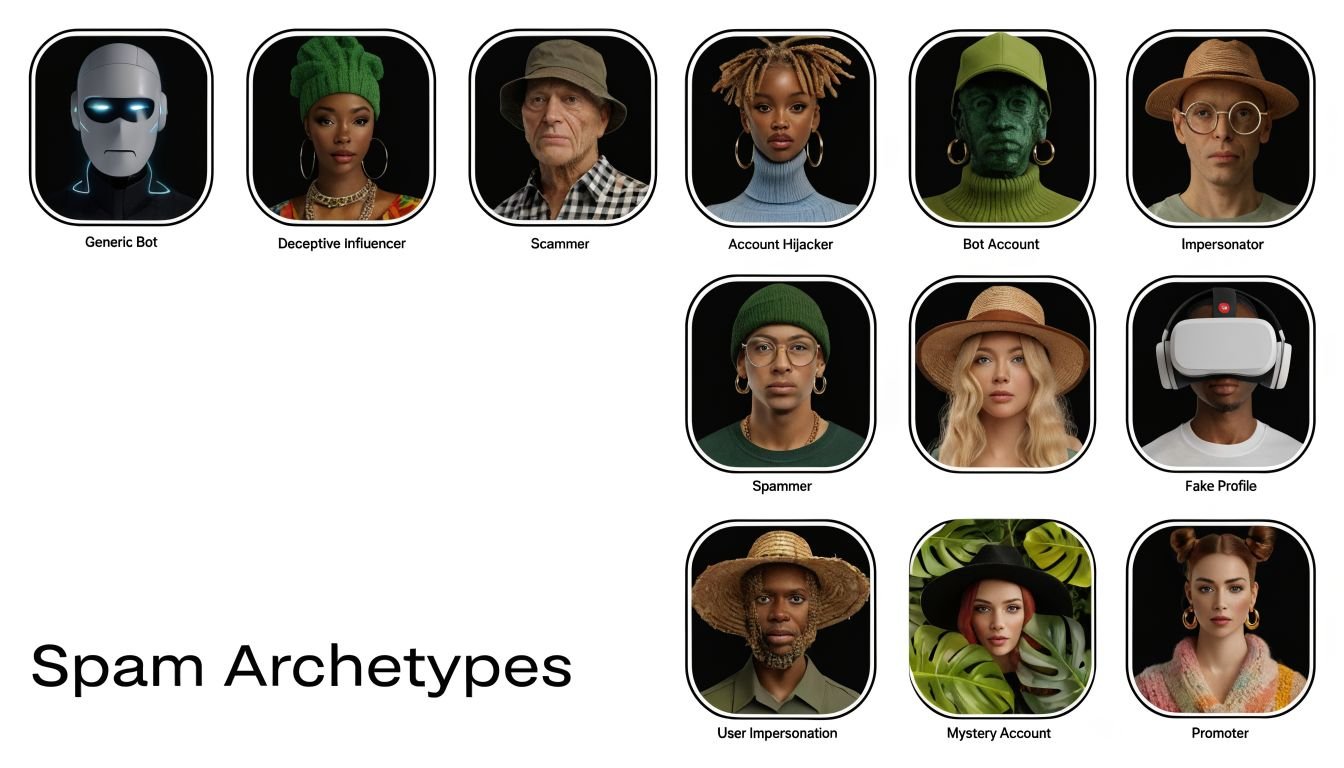
The account that wants your attention
You post a Reel. Within seconds, a comment appears: “Promote it on…” followed by a tag or a sketchy pitch. That's the comment spammer. Its goal is visibility, not conversation.
These accounts use volume. They latch onto active posts because they want your audience to see them, click away, or assume they're part of the discussion.
The account that wants your trust
You get a DM from “support” telling you your page is at risk and you need to verify it. Or a fake brand account contacts you about a partnership, then sends a bad link. That's the impersonator or phishing scammer.
This type works because it borrows authority. The profile may copy a logo, reuse brand language, or mirror a creator name with one extra character.
A spammer doesn't need to look perfect. They only need to look believable for a few seconds.
The account that wants your numbers
Then there's the follow-unfollow manipulator or low-quality growth account. It follows you hoping for a follow back, then disappears. Sometimes whole networks of these accounts exist to inflate perceived popularity.
These accounts may not always steal data, but they still pollute your metrics and clutter your audience with people who never intended to engage.
The account that wants your money
Crypto, trading, recovery services, miracle growth hacks, and “easy income” messages often come from financial spam accounts. The wording changes with trends, but the structure stays familiar. Big promise, urgency, little proof.
If you want a visual checklist for fake profile behavior on Instagram, this AI Image Detector guide to spotting bots is useful because it focuses on recognizable account-level clues rather than hype.
Why this keeps happening
Spam has changed platforms, not personality. As Abusix's history of spam explains, the problem evolved from email into social media ecosystems. The same source notes that early enforcement included Nicholas Tombros' 2007 conviction under the CAN-SPAM Act, yet spam still made up 45.37% of email traffic in late 2021.
That history matters because it explains why today's spam accounts are so adaptive. When one tactic gets filtered, spammers move to comments. When comments get blocked, they use DMs. When DMs get restricted, they impersonate support or creators.
A simple motive map
- Attention seekers want reach
- Impersonators want trust
- Growth manipulators want numbers
- Scammers want money or access
Once you identify the motive, your response gets easier. Delete, block, report, or tighten filters. You stop treating every weird account as a mystery and start seeing the playbook.
How Spam Accounts Hurt Your Brand and Analytics
Spam doesn't just make your comments look messy. It changes how people judge your account. A profile filled with fake-looking engagement can feel unreliable, even when your actual work is strong.
That brand damage is subtle. A real follower sees bot comments, scam replies, or waves of empty accounts in your audience and starts wondering whether your community is genuine. Trust drops fast when the space around your content feels unmanaged.
Bad audience data leads to bad decisions
Creators often watch follower growth, comment volume, link clicks, and story replies to decide what to make next. Spam distorts all of that.
If low-quality accounts click links, leave generic comments, or follow in bursts, your reports stop reflecting human interest. You might think a topic worked when it only attracted junk traffic. You might think a post failed when real engagement got buried under noise.
For teams that also use phone verification workflows in marketing or sign-up testing, it helps to understand services like quackr because temporary number ecosystems can intersect with disposable-account behavior. That doesn't make every temporary number suspicious, but it does explain why some fake account networks are easy to spin up.
The scale tells you this is not a small problem
Platforms fight spam at industrial scale. According to 99Firms' spam statistics roundup, Facebook stopped 11.6 million fake accounts at registration in 2020 and removed or blocked 98.3% of spam-related violations before users saw them.
That tells you two things. First, platforms see enormous volumes of abusive account activity. Second, they are constantly filtering, ranking, and suppressing suspicious behavior in the background. If your account gets surrounded by low-quality engagement, you don't want to assume it has no downstream effect.
What this looks like in practice
| Problem | What you see | Why it matters |
|---|---|---|
| Comment spam | Off-topic praise, scam pitches, repeated phrases | Makes your brand look poorly moderated |
| Fake followers | Audience count rises but conversation doesn't | Weakens social proof |
| Bot clicks | Strange traffic patterns to key links | Confuses content and campaign analysis |
| Impersonation replies | Fake support or fake partnership messages | Risks audience trust and customer safety |
Brand safeguard: Clean analytics matter as much as big analytics.
A smaller, more responsive audience is more useful than a larger polluted one. If you're trying to improve content strategy, lead quality, or audience trust, spam management is part of the job, not a side chore.
Your Action Plan for Reporting Blocking and Reducing Spam
When spam shows up, speed matters. You don't need a perfect system. You need a repeatable one.
Start with the built-in controls
Most major platforms already give you useful moderation tools. Use them consistently.
- Block obvious offenders immediately. If an account is sending scam DMs, posting malicious links, or impersonating a person or brand, block first.
- Report the account through the platform flow. Reporting helps platforms connect single incidents to larger abuse patterns.
- Hide or filter keyword triggers. On Instagram, TikTok, YouTube, and X, keyword filters can catch common spam phrases before they clutter public comments.
- Restrict when you're unsure. If an account seems off but not clearly malicious, restricting can reduce exposure while you watch behavior.
Clean up your own account signals
Spam protection isn't only about removing bad actors. It's also about making your own profiles look clearly legitimate.
- Keep branding consistent across your public accounts. Use recognizable names, bios, profile images, and contact details.
- Post in human rhythms instead of dumping identical content across several accounts at once.
- Avoid engagement schemes such as buying followers or joining low-quality “boost” groups.
- Separate account purposes clearly so your alt, test, or niche accounts don't mimic fake network behavior.
If you manage several accounts for work, build a simple internal rule set. Which account is public-facing? Which one is personal? Which one is for testing? Confusion inside your team often creates the exact inconsistency platforms dislike.
Handle the gray area with care
The social side of “spam accounts” gets trickier with finstas and private alts. The Her Campus article on Instagram spam accounts and finstas notes that 80% of youths use these accounts for more unfiltered sharing, and also cites a 2026 Pew Research study in which 62% of Gen Z users with finstas reported increased anxiety.
That doesn't mean secondary accounts are bad. It means they can create pressure, identity fragmentation, and moderation confusion. If you use one, keep the purpose clear. Personal close-friends account. Private hobby page. Client test account. The cleaner the role, the lower the risk of mixed signals.
A practical weekly routine
| Task | Frequency | What to look for |
|---|---|---|
| Review new followers | Weekly | Empty profiles, repetitive patterns, obvious scam bios |
| Check comments and DMs | Daily or near-daily | Link drops, fake support messages, copy-paste replies |
| Audit traffic sources | Weekly | Unusual spikes, low-quality click behavior, irrelevant referrals |
| Review your own accounts | Monthly | Consistent identity, posting rhythm, recovery access |
Don't try to win every battle manually. Build filters, review patterns, and act early.
That approach scales better than chasing each spam comment one by one.
Building an Authentic Audience in a World of Spam
The healthiest response to spam is not paranoia. It's clarity. Know what bad accounts look like, respond quickly, and keep building a space that real people want to stay in.
Authentic audience building usually looks less dramatic than spam fighting. You publish useful content. You answer real comments. You make it easy for people to understand who you are, what you offer, and where to go next. Over time, that consistency does two jobs at once. It attracts better followers and makes suspicious activity easier to spot.
What authenticity looks like operationally
A strong account usually has a few traits that work together:
- Clear identity so people recognize the profile immediately
- Relevant engagement from followers who match the topic
- Moderated community spaces where scam comments don't sit for days
- Thoughtful account structure if you run multiple profiles for different purposes
That last point matters more than most creators realize. Multi-account setups can be smart. One for your main brand, one for a niche project, one private account, maybe one for testing. Problems start when those profiles look disconnected, duplicate each other too aggressively, or send mixed trust signals.
Focus on quality signals you can control
You can't stop all spam from finding you. You can control how easy your account is to trust.
A good checklist is simple:
- Write bios that explain the account clearly
- Use recognizable profile images and naming
- Link only to destinations you manage
- Reply to genuine questions so real users feel seen
- Remove junk interactions before they shape the public impression
Real audience growth is slower than spam growth, but it gives you something spam never can. Reliable trust.
That's the part many people skip when they ask what's a spam account. The better question is often, “What kind of account am I training people and platforms to see?” If your accounts are coherent, useful, and well-managed, you're easier to trust and harder to confuse with low-quality actors.
The goal isn't just fewer bots. It's a cleaner, calmer, more credible online presence.
If you want one place to present your real links, content, products, and contact options without scattering people across multiple bios, Bio Links Page Builder makes that easy. You can create a clean, professional page that supports your main brand, reduces confusion across accounts, and gives your audience one clear destination to trust.