
You publish a post you know is useful. It solves a real problem, answers the obvious questions, and reads better than half the pages already ranking. Then nothing happens. A few clicks from social. A couple of readers from your email footer. Search stays flat. The post disappears into your archive.
That's where most bloggers get stuck. They treat traffic like an outcome of publishing, when it's really the result of a system. If you want to learn how to drive traffic to your blog in 2026, stop looking for a single winning tactic and start building a traffic portfolio.
A traffic portfolio spreads your attention across channels that behave differently. Search brings intent. Social creates discovery. Email drives repeat visits. Partnerships borrow trust. A centralized links hub keeps all of it organized, measurable, and easier to improve. If one platform gets less reliable, the whole system doesn't collapse.
Table of Contents
- Beyond 'Hit Publish' to Building Your Traffic Engine
- Mastering Search for Sustainable Organic Growth
- Social Media and Content Repurposing That Works
- Creating a Loyal Audience with Email Marketing
- Expanding Your Reach with Partnerships and Paid Ads
- Unifying Your Promotion with a Bio Links Page
Beyond 'Hit Publish' to Building Your Traffic Engine
A blog post goes live on Tuesday. By Friday, it has a few clicks, one social share, and then nothing. The problem usually is not the post itself. The problem is treating publishing like the finish line instead of the start of distribution.
Traffic grows faster when each post is built to do more than one job. A strong article should support search visibility over time, give you something timely to send to subscribers, create several social assets, and strengthen the rest of your site through internal links. That is how a blog starts acting like a traffic engine instead of a content archive.
I use a traffic portfolio approach because single-channel growth is fragile. Search can dip after an update. Social reach can disappear with one platform change. Referral traffic can dry up when a partner stops publishing. A healthier setup spreads effort across channels that behave differently, then ties them together with one clear promotion path.
That promotion path matters. If someone finds you on LinkedIn, a podcast mention, or a short-form video, they should land in the same controlled hub instead of bouncing between disconnected profiles and old links. A centralized bio links page makes that system easier to manage and easier to measure, especially when you want to compare which channels move readers into your blog, email list, or offers.
Consistency still matters, but the essential trade-off is consistency in promotion, not just volume. Publishing more often can help, yet uneven distribution wastes good content. I would rather see one strong post promoted across search, email, social, and a bio links page for four weeks than four posts published and forgotten after one day.
Use a simple standard: every post should earn at least three distribution touches after it goes live. If it cannot support that, the topic is probably too narrow, the angle is unclear, or the piece is not useful enough yet.
For a broader view of channel mix, this guide to essential traffic generation strategies is a useful companion. The point is not to be everywhere. The point is to build a traffic portfolio that can absorb shocks and keep producing results.
That only works if your message stays consistent across channels. A practical planning resource like this brand strategy template helps keep your audience, positioning, and content angle aligned, so every visit from search, social, partnerships, or your bio links page feels like it came from the same brand.
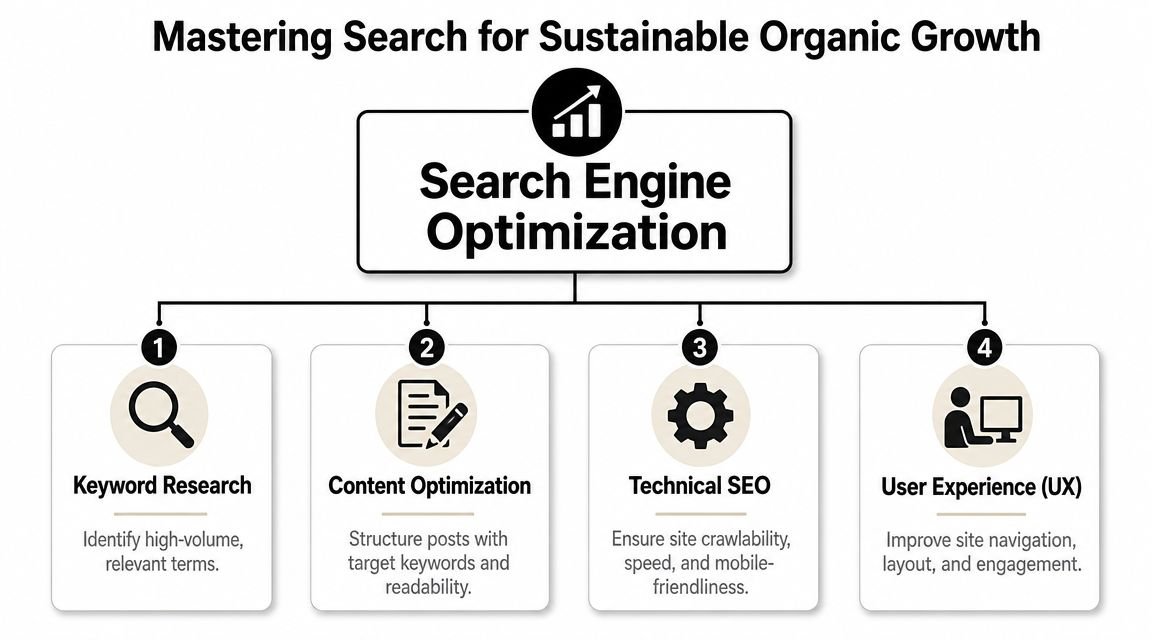
Mastering Search for Sustainable Organic Growth
Search is still the most dependable traffic source for many blogs because it captures readers with intent. They're already asking the question. Your job is to show up with the clearest answer and make the page easy for both humans and search engines to understand.
Start with the audience, not the keyword
Most weak SEO starts in the wrong order. The writer picks a vague topic, drafts a post, then tries to force a keyword into it at the end. That usually creates bloated content and mismatched intent.
A better workflow is laid out in Bluehost's practical guide on how to increase blog traffic. The sequence is simple: identify a specific audience segment and the questions they search for, validate keywords with tools such as Google Keyword Planner, Ahrefs, or SEMrush, place the target term in the title, subheadings, image alt text, meta description, and body copy, then add internal links so the new page connects to related content.
If you're building your process, keep the search brief focused on these questions:
- Who is this for: A beginner, evaluator, buyer, or returning reader?
- What are they trying to do: Learn, compare, fix, or choose?
- What would make them leave disappointed: Too much fluff, missing steps, outdated examples, or unclear recommendations.
Search intent decides structure. A “how to” query needs steps. A “best tools” query needs comparison logic. A “what is” query needs a clean definition first, depth second.
Use a simple on-page checklist
On-page SEO doesn't need to be complicated. It needs to be complete.
- Title and heading alignment: Put the primary term in the title and at least one subheading, but make the heading readable first.
- Body relevance: Use the term naturally throughout the copy where it helps clarify the topic.
- Metadata and media: Include the term in the meta description and image alt text when relevant.
- Internal links: Link to related posts that help the reader go deeper or take the next step.
Many bloggers often leave traffic on the table. They optimize only the title, or only the first paragraph, and wonder why the page doesn't gain momentum. Search engines look for distributed relevance, not one isolated signal.
If you want another practical reference point, EvergreenFeed's walkthrough on SEO strategies for your blog is worth reading alongside your own checklist. For strengthening your internal linking habits, this guide on how to get free link juice is also useful.
What usually goes wrong
The common failures are predictable:
| Mistake | What it causes | Better move |
|---|---|---|
| Writing before validating demand | Posts that never match real searches | Confirm the query before outlining |
| Keyword stuffing | Awkward copy and weaker UX | Spread relevance naturally across the page |
| Weak internal linking | Readers stop at one page | Link to the next logical article |
| Ignoring search intent | High impressions, low engagement | Match the content type to the query |
Search works best when the post is useful without SEO, then made easier to interpret with SEO.
If you're serious about how to drive traffic to your blog, search deserves a repeatable workflow. Not because it's glamorous, but because it keeps paying after the publish date.
Social Media and Content Repurposing That Works
Most social promotion fails because bloggers post a link and call that distribution. People on social platforms rarely want to leave immediately for a full article. They want a useful idea in the format they already came for.
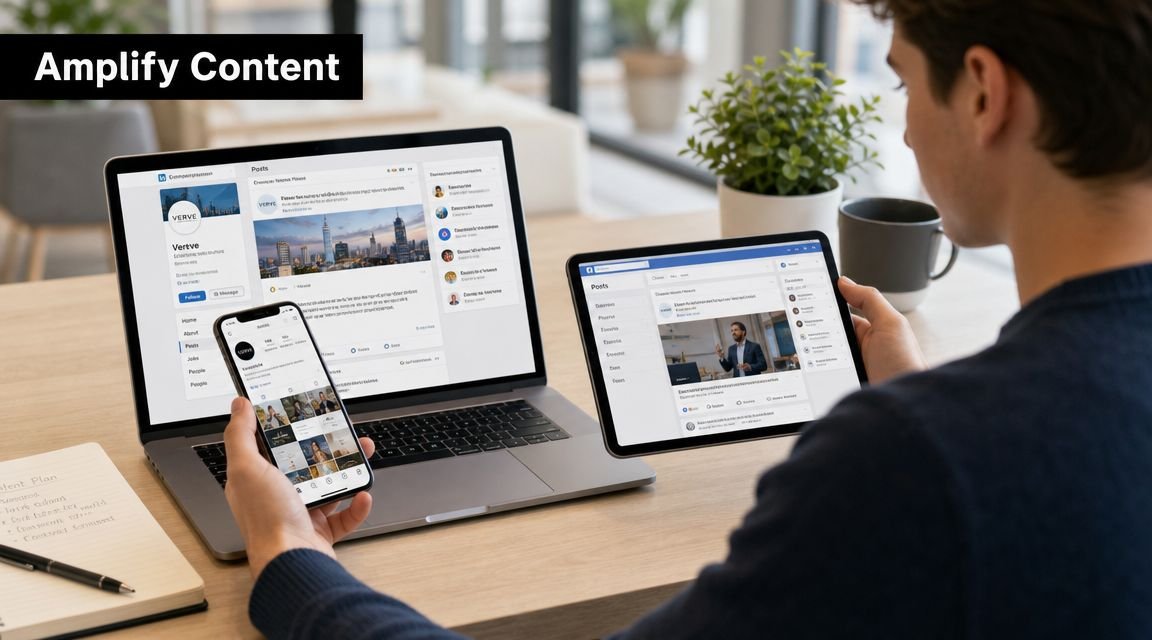
Recent creator guidance increasingly emphasizes turning blog posts into short-form video, pin graphics, and platform-native snippets, then linking back to the full article, as discussed in this creator-focused YouTube resource. That matters because discovery behavior has shifted toward visual and social search on platforms such as YouTube Shorts, TikTok, Instagram, and Pinterest.
One post, five assets
Take a standard blog post, say a guide to starting a newsletter. Don't promote it once. Break it apart.
You can turn it into:
- A short-form video: One mistake, one insight, one action step.
- An Instagram carousel: A swipe-by-swipe framework pulled from the post structure.
- A Pinterest graphic: An evergreen visual for a practical tip or checklist.
- A text thread or caption series: One argument or mini-lesson extracted from the article.
- An email teaser: A short summary with one clear reason to click through.
That's not content duplication. It's format adaptation.
Match the format to the platform
Different channels do different jobs. Treat them that way.
- Short-form video for reach: Good when the topic is visual, opinionated, or easy to demonstrate.
- Pinterest for evergreen referral: Useful when your post solves recurring problems people search visually.
- Instagram carousels for saves and shares: Strong for frameworks, lists, and before-and-after transformations.
- Text-led platforms for argument and commentary: Better for contrarian takes, lessons learned, and fast reactions.
A blog post about workflow might become a reel showing the setup, a carousel listing the steps, and a pin linking to the full article. The underlying idea stays the same. The wrapper changes.
For creators leaning into video-led distribution, this tutorial on TikTok video creation can help you build platform-native content faster.
Don't ask, “Where should I share this link?” Ask, “What version of this idea belongs on this platform?”
Here's a good explainer to watch before you build your next repurposing workflow:
Build a repeatable campaign, not a one-time share
When I launch a post, I don't think in terms of a single announcement. I think in terms of a mini-campaign.
A simple campaign might look like this:
- Publish the article with search basics in place.
- Create two social formats the same day, usually one visual and one short-form.
- Reshare the core insight later from a different angle, not the same caption.
- Pull one subsection into a standalone post the following week.
- Route interest to one destination so the traffic lands somewhere intentional.
Social traffic is uneven. Some posts disappear. Some keep resurfacing. The bloggers who win here don't post more links. They create more entry points.
Creating a Loyal Audience with Email Marketing
A search update can cut clicks in half. A social platform can bury outbound links for a week. An email list gives you a traffic source you can reach on your schedule, which is why it belongs in any traffic portfolio built to survive platform volatility.
Email does a different job than search or social. Search helps people discover you. Social expands reach and gives ideas more surface area. Email brings the right readers back to your blog repeatedly, which is what turns occasional spikes into steady traffic.
That matters because repeat visitors behave differently. They spend more time with your content, click into related posts, and develop familiarity with your point of view. If you also use a centralized bio links page across your profiles, email becomes one more trackable channel feeding the same promotion system instead of operating in isolation.
What to offer people before you ask for regular attention
A signup form by itself rarely converts well. Readers join when the offer matches the problem that brought them there.
Use one lead magnet tied to your core topic and your highest-intent posts. A broad freebie brings broad subscribers, which usually means weak click activity later. A focused freebie attracts readers who want more of the same subject.
Good fits include:
- A checklist for process-heavy tutorials
- A template for writing, planning, outreach, or operations topics
- A resource list for tool-driven or research-heavy subjects
- A short email course for topics that make more sense in sequence
The goal is simple. Pre-qualify the subscriber before they ever join your list.
What to send if you want clicks, not just subscribers
Many bloggers train their list to ignore them by sending the same type of email every time. A better approach is to mix formats based on the action you want.
| Email type | Primary job |
|---|---|
| New post email | Send early traffic to a fresh article |
| Curated email | Bring older posts back into circulation around one topic |
| Insight email | Teach one useful point, then link to the full article |
| Subscriber-only email | Build habit with content people cannot get from a social post |
A healthy email program also respects cadence. Weekly usually works better than bursts of activity followed by silence. Readers do not need more volume. They need a clear reason to click.
One practical rule I use is this: every email should answer, "Why should this reader visit the blog today?" If the answer is weak, the send is probably premature.
What to measure every month
Email traffic is easy to overvalue or undermeasure. Watch the metrics that show quality, not just list size.
- Subscriber growth: Are qualified readers joining consistently?
- Click rate: Are emails generating visits to the blog?
- Open rate: Are subject lines and sender trust strong enough to earn attention?
- Traffic by post: Which articles attract repeat visits from email?
- Unsubscribe pattern: Do exits spike around certain topics, formats, or send frequency?
These metrics work together. Strong growth with weak clicks usually means the signup offer is misaligned with the content you send. Good opens with soft traffic often points to weak email body copy or a vague call to action. Strong clicks with poor on-page engagement usually means the article did not match the promise in the email.
That last point gets missed a lot. Email can drive traffic fast, but it also exposes weak content alignment fast.
Treat your list as an owned distribution asset inside a broader traffic portfolio. Search can fluctuate. Social can stall. Email gives you a reliable way to reactivate readers, route them to priority posts, and send traffic through links you can track alongside the rest of your channels.
Expanding Your Reach with Partnerships and Paid Ads
A traffic portfolio gets stronger when every channel does a different job. Search brings intent. Email brings repeat visits. Partnerships bring borrowed trust. Paid distribution gives you controlled tests at speed.
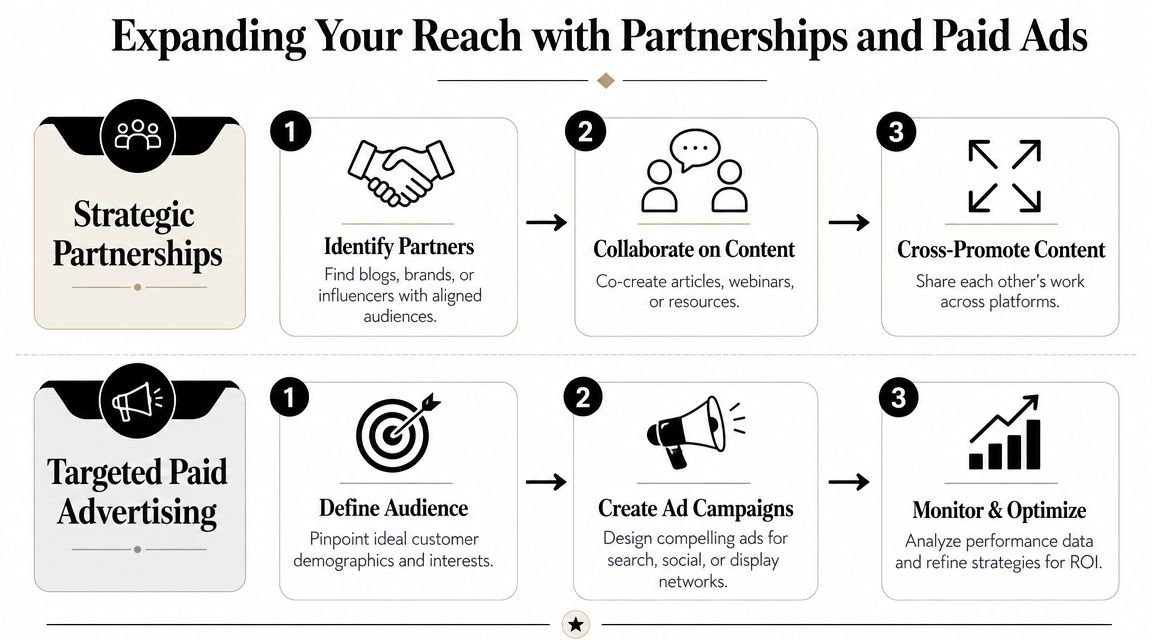
If all traffic growth depends on one platform, a single algorithm change can stall the whole system. Partnerships and paid ads reduce that risk. They also reveal something useful fast. Whether your article earns attention outside your existing audience.
Guest posting that sends qualified readers
Guest posting still works, but only when the goal is referral quality, not vanity placement.
The best opportunities are usually smaller than people expect. A niche newsletter with engaged readers can outperform a large site with weak audience fit. I have seen guest posts send modest traffic and still win because those visitors subscribed, read multiple posts, and came back later through direct or email traffic.
Start by mapping audience overlap. Look for blogs, creators, podcasts, communities, and newsletters that already speak to the readers you want. Then pitch an idea that fills a gap in their content instead of offering a generic contribution.
A strong pitch includes:
- Clear audience fit: Show that you understand their readers' current problems and interests.
- A specific idea: Offer a defined headline or angle, not a vague offer to write.
- A practical payoff: Explain what the audience will learn and why the topic matters now.
Once the piece goes live, measure it like a channel, not a one-time win. Track referral sessions, email signups, pages per session, and return visits from that source. If the traffic bounces fast, the issue is usually one of three things: weak audience match, weak article-to-landing-page alignment, or no obvious next step after the click.
That next step matters. Send partnership traffic to a post that naturally points readers toward related articles, a signup offer, or your central Bio Links Page. Borrowed attention has a short half-life. Give readers one place to continue.
When small paid tests make sense
Paid promotion works best after a post has already shown signs of traction. Ads increase reach. They do not repair weak positioning or a weak article.
Use paid social and content discovery campaigns as controlled experiments. Put a small budget behind content that already earns solid time on page, organic shares, comments, or email clicks. That usually means the core promise is working.
Good candidates include:
| Good paid test | Why it works |
|---|---|
| A practical guide | It matches a clear problem and search intent |
| A lead-generation article | It turns rented traffic into owned audience |
| A proven evergreen post | It keeps producing value after the spend stops |
Poor candidates are broad opinion posts, trend reactions with a short shelf life, and articles that ask for a click without offering a clear outcome.
Watch the full path, not just the click price. A cheap visit that never reads, subscribes, or returns is not efficient. A more expensive visit can still be profitable if it joins your list or moves deeper into your content library.
Build campaigns around follow-through
Partnerships and paid traffic perform better when the destination is ready for them.
A reader who lands from a guest article should see proof that your site is active and worth exploring. A reader who clicks a paid promotion should arrive on a page with a clear promise, a strong opening, and an obvious next action. That can be a related article, an email opt-in, or a centralized links hub that helps them find your best resources without friction.
Many blog promotion efforts encounter operational breakdowns. Traffic comes in from several sources, but each source points to a different page, uses different tracking, and creates a messy reporting picture. A centralized Bio Links Page helps keep partnership placements, creator mentions, and paid promotions organized under one trackable destination when that makes more sense than sending people to a single post.
The goal is resilience. Partnerships give you access to trusted audiences. Paid tests help you validate what deserves more distribution. Used together, they make your traffic portfolio less exposed to platform volatility and easier to measure channel by channel.
Unifying Your Promotion with a Bio Links Page
A common traffic problem shows up after a few months of consistent publishing. Your Instagram bio points to one post, your newsletter links to another, an old guest contribution sends readers to your homepage, and your pinned content still promotes a resource you replaced weeks ago. Traffic does not stop. It fragments.
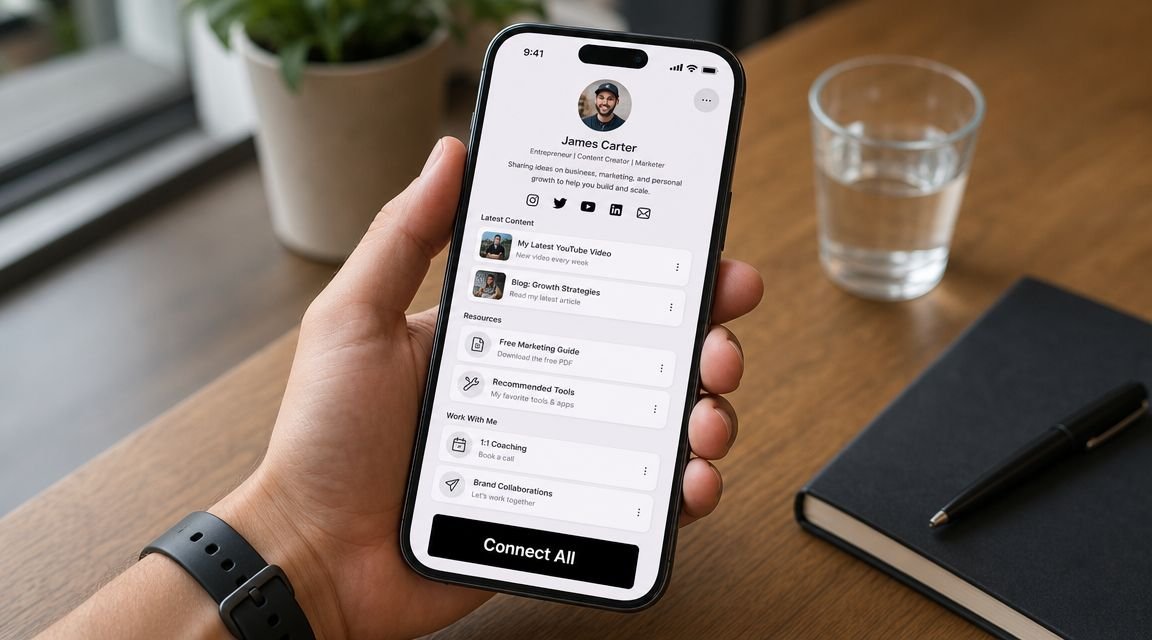
A bio links page fixes the distribution layer. It gives your traffic portfolio one controlled entry point, so you can promote across channels without rebuilding your setup every time priorities change.
Why a central hub improves channel performance
Search, social, email, partnerships, and paid campaigns do different jobs. They also break in different ways. Search traffic can dip after an algorithm update. Social reach can collapse when a platform changes distribution. Paid traffic can get expensive fast. Email is more stable, but list growth takes time.
That is why I treat blog growth like a traffic portfolio, not a single-channel bet. A central links hub supports that approach because it gives every channel a shared destination you can update, tag, and measure consistently.
Instead of swapping every profile link whenever a new post goes live, send readers to one page that highlights:
- your current priority article
- your email signup
- your cornerstone content or category pages
- your social profiles
- your evergreen resources
This setup reduces operational mess and improves reporting. You can see which channels send clicks, which links get attention, and which offers pull readers deeper into your site.
What to put on the page
A useful bio links page needs hierarchy. If everything is featured, nothing is featured.
Use the top position for the action that matters most right now. That might be a new article, a lead magnet, or a seasonal campaign. Put email signup near the top because many visitors are interested but not ready to read multiple posts on the spot. Then add a middle layer of evergreen content that helps new readers self-select into your best topics. Keep lower positions for social profiles, contact options, or service pages that support trust but do not need prime placement.
I usually review this page the same day I publish a post and again at the end of the month. That second check matters. It shows whether the page still reflects current priorities or has started collecting outdated links.
If you want one tool for this, Bio Links Page Builder creates a single OneURL page that can centralize articles, signup links, social profiles, and other content blocks in one mobile-friendly hub.
Blog Traffic Channel Comparison
| Channel | Effort Level | Result Speed | Key KPI |
|---|---|---|---|
| Search | Medium to high | Slow to medium | Qualified organic visits |
| Social | Medium | Fast | Clicks to article or hub page |
| Medium | Fast | Click-through rate | |
| Partnerships | Medium to high | Medium | Referral traffic quality |
| Paid ads | Medium | Fast | Cost-efficient visits to a defined page |
The point is not to rank channels. It is to assign each one a job and reduce dependence on any single source.
A simple operating checklist
Use this checklist every time you publish:
- Set one primary goal: Decide whether this cycle is meant to drive article reads, email signups, or clicks into a topic cluster.
- Update the hub first: Make sure your top links reflect the current campaign before new social posts or emails go out.
- Add tracking consistently: Use clear UTM naming so channel performance is easy to compare later.
- Match the link order to intent: Put fast-conversion actions higher and lower-intent profile links further down.
- Review concentration monthly: If one channel is carrying too much of the load, invest in another before performance drops.
That last step protects resilience. A blog that gets most of its traffic from one source can grow quickly, but it is fragile. A blog with a balanced traffic portfolio usually grows more steadily and is easier to recover when one channel weakens.